
Bearded dragons (Pogona vitticeps) are fascinating reptiles with plenty of personality. They can make wonderful companions, but good bearded dragon care in Dubai involves much more than providing a tank and a heat lamp.
Our longtime patient, Diesel, was a wonderful example. When he was three months old, he could fit into his owner’s palm; over the years, we watched him grow into a much-loved family member. Read Diesel’s story for a glimpse of the long-term commitment involved. With appropriate care, bearded dragons can live for approximately 10 to 15 years.
So, what does a healthy bearded dragon setup actually need?
Start With the Species, Not the Equipment
Bearded dragons originate from Australia’s semi-arid and arid woodlands, grasslands and rocky desert. They are diurnal, so they are active during the day and naturally spend significant time basking. A successful enclosure must reproduce the choices this habitat provides: heat and shade, UVB exposure, secure hiding places, climbing opportunities and room to move.
They are also naturally solitary. Sexually mature males can be particularly territorial, and dragons housed together may compete for heat, food and space even when obvious fighting is absent. Individual housing is generally the safer option.
Build a Safe Bearded Dragon Enclosure
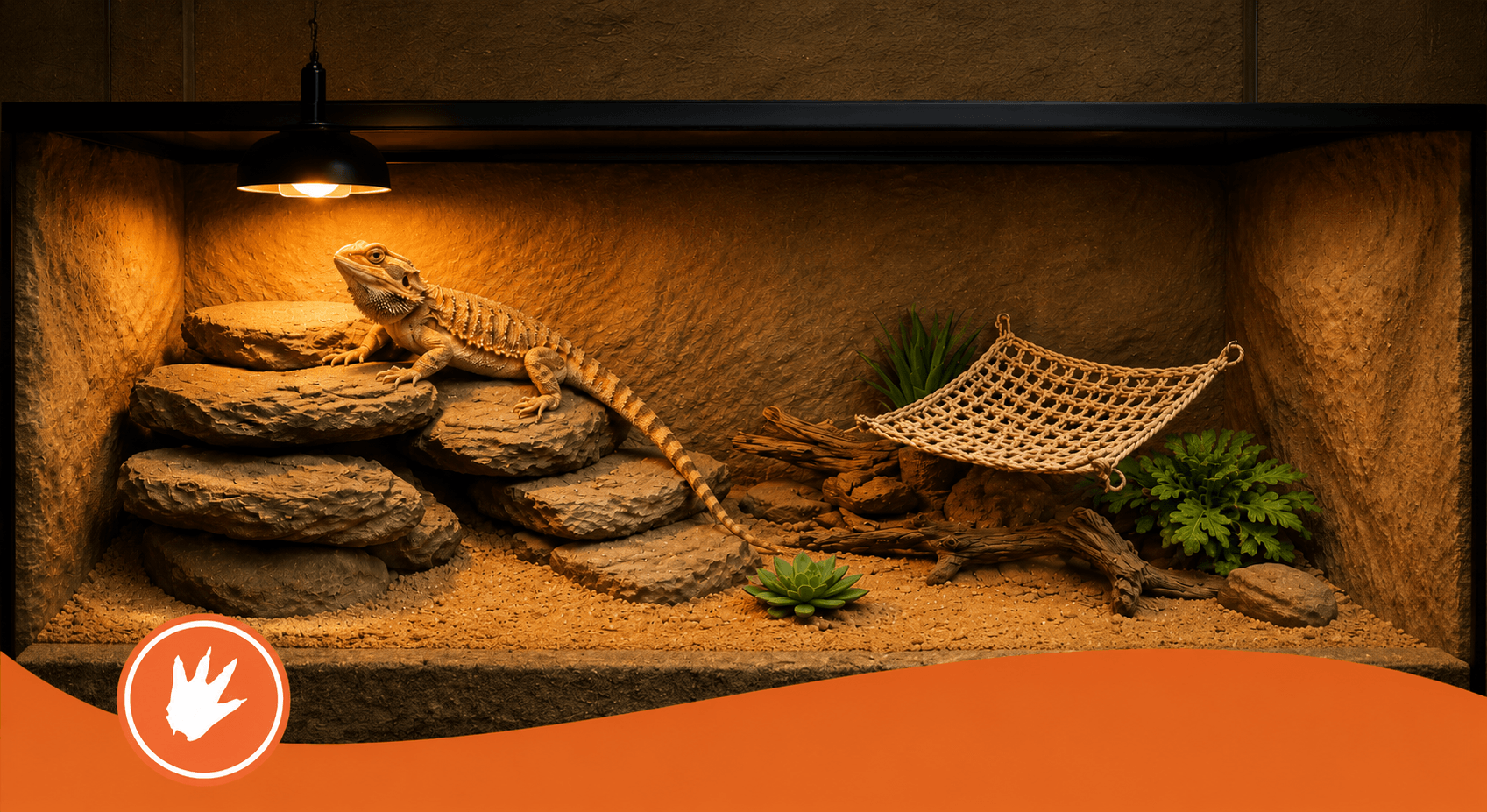
A good bearded dragon enclosure should allow its occupant to move between different temperature zones, bask, climb, hide, and explore. The supplied husbandry guidance recommends a vivarium of approximately 6 ft x 2 ft x 2 ft, with good ventilation and low humidity. Larger enclosures can provide more scope for natural behaviour when the temperature and UVB gradients are maintained correctly.
Use stable climbing logs, cork bark, rocks and hides to create different levels. Keep routes open enough for the dragon to turn comfortably, and ensure heavy items cannot shift or fall. This makes the bearded dragon setup more than a display: it becomes an environment the animal can actively use.
Choose Substrate With Behaviour and Safety in Mind
Avoid bark, wood chips, calcium sand, and compacted pellets. Large or unsuitable particles can be swallowed, while low enclosure temperatures or dehydration can reduce normal digestion and increase the risk of impaction, a blockage caused by material that cannot pass through the digestive tract.
Digging is natural, particularly for females preparing to lay eggs. A designated dig box containing an appropriate reptile-safe sand-and-soil mixture can provide an outlet for this behaviour, while safer, easy-to-clean surfaces are used elsewhere.
Create a Reliable Temperature Gradient
Bearded dragons are ectothermic, which means they depend on their surroundings to warm and cool their bodies. A proper gradient lets the dragon choose the temperature it needs for activity and digestion. As a practical guide:
- Basking area: approximately 38-42°C
- Cool side: approximately 22-26°C
- Night-time: generally no lower than approximately 20-22°C
Use a guarded basking bulb above the basking area, controlled safely, and digital thermometers with probes to measure the basking zone and cool end. Avoid heat rocks because direct contact can cause burns. Record temperatures at the dragon level rather than relying on the thermostat setting alone.
Dubai’s outdoor heat does not guarantee a correct indoor gradient. Air conditioning can cool a vivarium considerably, while sunlight through a window can cause rapid overheating. For reliable bearded dragon care in Dubai, monitor conditions inside the enclosure daily.
UVB Lighting Is Essential
Correct UVB exposure supports vitamin D3 production, calcium use and healthy bones. A suitable setup may include a high-output T5 linear UVB tube, commonly 10-12%, spanning roughly half to two-thirds of the enclosure. Position it so that the UVB zone overlaps the basking area, while the cool end provides shade.

The right strength and distance depend on the lamp, reflector, mesh and enclosure height, so follow the manufacturer’s positioning guidance. UVB does not pass effectively through glass, and output declines as a lamp ages, even when it still looks bright. Check the output where possible and replace the lamp at the recommended interval. An exotic vet in Dubai can review the setup during a consultation.
Do Not Forget Enrichment

A healthy enclosure is not only about temperature and lighting. Branches, logs, rocks, hides, and different levels create opportunities to climb, retreat and explore. Rotate safe features occasionally without removing all familiar landmarks at once.
Gentle, well-supported handling can also help a beardie become comfortable with human interaction, but follow the animal’s cues and keep sessions short enough that it does not become chilled.
Brumation or a Sign of Illness?
Adult bearded dragons may become less active and eat less during cooler periods, a natural process known as brumation. The difficulty is that illness can look similar. If your dragon becomes unusually lethargic, stops eating, loses weight, breathes differently or simply does not seem like itself, do not assume it is brumating. Our guide to signs of pain in exotic pets explains why small behavioural changes deserve attention.
Many reptile health problems are closely linked to husbandry. Reviewing the enclosure, temperature records, UVB lamp, diet, and recent weight trend can provide the veterinary team with valuable context. If you are bringing home your first dragon or are unsure whether the current setup is right, the 2Feet4Paws Veterinary Clinic exotics team provides health checks and practical husbandry guidance.
Make the Setup Part of Preventive Care
Good bearded dragon care in Dubai depends on creating measurable conditions rather than assuming the equipment is working. Check temperatures, observe normal behaviour and appetite, record weight and reassess the enclosure as your dragon grows. If you would like the setup reviewed, contact our exotics team.
Next: read What Should a Bearded Dragon Eat? Nutrition, Supplements & Signs of Illness: connect the enclosure with the diet, supplementation, and warning signs that support long-term health.
